Captain Francis Fowke
Francis Fowke was born in Ballysillan, Northern Ireland on 7 July 1823, he was educated at Dungannon College and given private military tuition before entering the Royal Military Academy, Woolwich in 1839. He was commissioned into the Royal Engineers in 1842. From an early date in his career he displayed considerable inventive ingenuity. When stationed at Bermuda, as a young subaltern, he excited attention by numerous clever devices connected with the rigging of yachts, his tastes having led him to spend much of his time in sailing.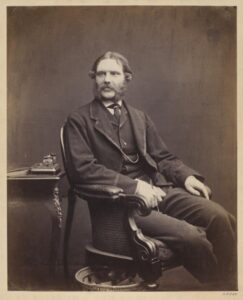
He married Miss Louisa Rede in 1845. On his return to England he was sent to Devonport, where he gave the first signs of the brilliant architectural and constructive genius for which he was afterwards celebrated. The Raglan Barracks at that station were entirely designed by him, and in this work he introduced many useful novelties for the benefit of the soldier. Some of these were at first but little appreciated, but they have since been generally adopted in all new barrack-constructions. His inventive powers were not meanwhile idle in other directions:
- He designed a drawbridge on a most ingenious principle.
- He devoted much thought to the adaptation of rifling to heavy ordnance for the use of elongated projectiles. In this he was the precursor of both Armstrong and Whitworth.
- Pontoons also attracted his attention, and he invented one on a collapsing principle, which, although not adopted at home, met with much success in America.
- He invented a military fire-engine, which was made to limber up like a field gun and saw service with the British Army in the 1860’s.
- In May 1856 he patented a folding photographic camera, which he later developed into what became commonly known as the ‘bellows’ camera.
In 1854 he was invited by Captain (later Brevet Colonel) HC Owen (1821-67) RE, who was Secretary to the British Commissioner for the Paris Exhibition of the following year, to assist him in superintending the Machinery Department. This he undertook to do, and when Captain Owen was called away from his post to proceed to the Crimea, Fowke took his place as Secretary. For his services in this capacity he was nominated to the Legion of Honour, but as the decoration was given for civil and not for military service, he was refused permission to wear it. At the conclusion of his Paris work he was attached to the newly formed Science and Art Department as an Inspector, and on its transfer from Marlborough House to South Kensington, he was charged with the superintendence of the buildings to be erected there. This was no easy matter. Sir William Cubitt (1785-1861) had constructed some long iron sheds with semi-circular roofs, since nicknamed the Brompton Boilers, and in their vicinity stood a cluster of old houses. These were the original materials which he was called on to develop into a museum. One of his first efforts in this direction was the design for a gallery to contain the pictures presented to the nation by John Sheepshanks (1787-1863), a wealthy Yorkshire cloth manufacturer. This gallery proved so successful that he was called on to add others for the reception of the Vernon and Turner bequests. Cole, in his Life of Fowke, narrates: That Fowke was staying with the Marquis of Salisbury at Hatfield, the Chancellor of the Exchequer (Mr Disraeli) being also present. The Marquis informed Fowke, late at night, that the Treasury had decided on carrying out the work, and wished it to be vigorously pushed forward. The next morning at breakfast, Disraeli asked Fowke how soon it could be begun. ‘How so? You only knew last night at twelve’. ‘I was at the telegraph office at Hatfield as soon as it was open. I ordered the works to begin, and I have received an answer that the foundations are being dug’. I call that work’, said Mr Disraeli.
For the remainder of his life he was engaged on architectural and engineering works:
- He designed the interior of the Dublin National Gallery, the elevation for which had already been decided on.
- The Museum of Science and Art at Edinburgh.
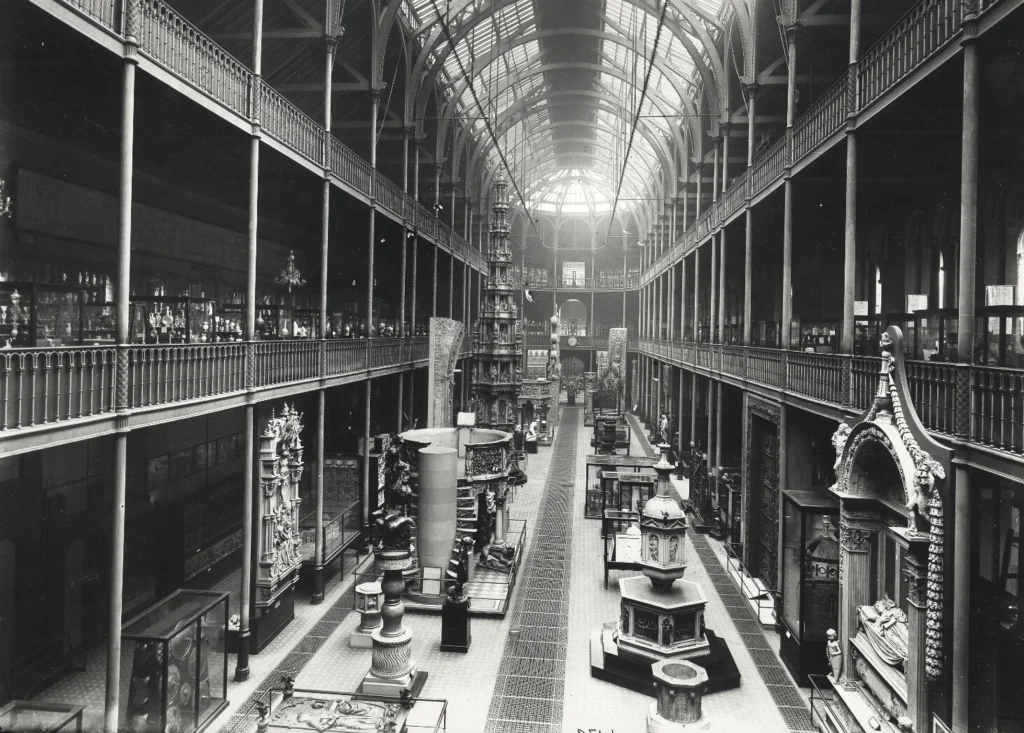
- He planned a drill shed for the 1st Middlesex Engineer Volunteers, covering 100 feet by 40 feet, which Sir Joseph Paxton (1801-65), designer of Crystal Palace (1851), pronounced the cheapest structure he had ever seen. The only funds available amounted to £100, and it cost no more. The principle he there devised has since been freely adopted elsewhere.
- When a part of the ground purchased by the Commissioners of the Exhibition of 1851 was being laid out for the Horticultural Society, he gave the general plan, and designed the conservatory and south arcade. In the first of these he introduced gas with such perfect ventilation, that even when most brilliantly lighted the plants in no way suffer.
- He designed the structures for the International National Exhibition of 1862.
- He designed the Officers’ (later named Prince Consort’s) Library (now a Grade II listed building) at Aldershot for the Prince Albert (1819-61), whose gift it was to the camp. The Prince sent him a box of instruments with the following inscription : “Captain Francis Fowke, Royal Engineers, as a token of regard from Albert, 1859.”
When it had been decided that the Exhibition buildings should be removed, the Government purchased from the Commissioners of 1851 a portion of the site for the purpose of erecting a Natural History Museum, to accommodate an overspill from the British Museum. An open competition was arranged for the production of a design. The judges were Lord Elcho (Francis Wemyss Charteris (1818 – 1914), later 10th Earl of Wemyss & March), Mr Tite, Mr Fergusson, Mr Pennethorne and Mr D Roberts. Their award of the first prize was given to the set of designs marked Ad ogni uccello il suo nido e bello. When the sealed envelopes containing the competitors’ names were opened, it was found that Captain Fowke was the successful architect.
His premature death prevented the execution of his work, and the Natural History Museum now standing on the site is the production of Mr Alfred Waterhouse (1830 – 1905), who altered Fowke’s design from Renaissance to German Romanesque in style.
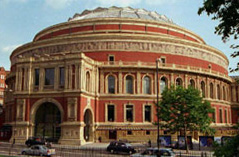 Fowke also drew up plans for the permanent buildings of the South Kensington Museum and lived to carry out some of them. In 1864, he produced his last great work, the general design for the Albert Hall, which was completed after his death by Major General Henry Scott (1822 – 83). Meanwhile, in the intervals of his more important studies, he had been giving free play to his inventive powers. Amongst the list of these productions of his genius may be named a very portable military fire-engine, a collapsing photographic camera, an improved umbrella, for which he took out a patent, a portable bath and a machine, by means of which, hundreds of gas-burners can be lighted in a few seconds. This was adopted at the South Kensington Museum.
In the spring of 1865, Captain Fowke found his health broken down from overwork and went abroad to seek recovery. This, however, was not to be. Although he became slightly better from the cessation of active work, the benefit was but transitory. He returned home, and after a short stay at Eastbourne came back to South Kensington, where, on 4 December 1865, two days after his arrival, he died from the bursting of a blood-vessel. A bust of him by Woolner has been placed in the Museum. This brief record of the most brilliant constructive architect that the Corps has produced, cannot be better closed than by quoting the words pronounced by Sir Henry Cole (1808 – 82), Director of the South Kensington Museum, at the Society of Arts, in alluding to his death:
Sustained a great loss by Captain Fowke’s death. At this period, when art is so transitional, and science is making so many discoveries, and men’s minds are seething with inventions, when the use of new materials is constantly entered upon, England has lost a man who felt the spirit of his age and was daring enough to venture beyond the beaten path of conventionalism. Captain Fowke, to my mind, was solving the problem of the decorative use of iron, and by appreciating the spirit, both of the Gothic and Renaissance architects, was on the threshold of introducing a novel style of architecture when, alas! death, at the early age of forty-two years, has cut short his promising career.
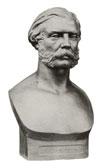 The Fowke Medal was introduced by the Institution of Royal Engineers in memory of Francis Fowke in 1866, to be awarded
 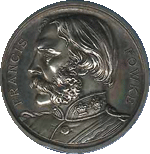 annually to a young officer considered to have specially distinguished himself in the School of Construction (of the School of Military Engineering). Today it is reproduced in bronze and awarded to the top student in each of the Clerk of Works (Construction), (Electrical) and Mechanical) and Military Plant Foreman’s courses at the RSME.