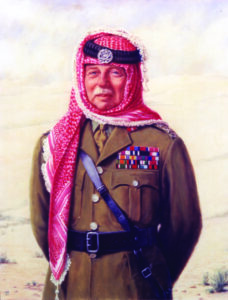
Lieutenant General Sir John Bagot Glubb kcb cmg dso obe mc
John Bagot Glubb, Jack to his family and friends, was born in Preston on 16th April 1897. His father, Frederic Glubb, at that time a major in the Royal Engineers, had a distinguished army career, retiring in 1920 as a major general. 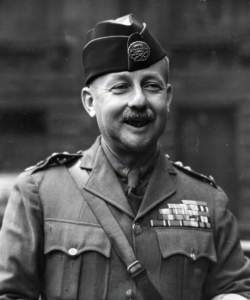
On the outbreak of war in 1914, Jack, then in his last year at school in Cheltenham, wanted to enlist immediately in the Rifle Brigade, but was dissuaded from doing so by his father. He was then persuaded to apply for admission to the Royal Military Academy in Woolwich and was commissioned into the Royal Engineers in April 1915. As he was considered too young to go immediately to France – the minimum age of 18½ was later abolished as casualties grew – he had to kick his heels at the Royal Engineers Depot in Chatham until November of that year.
His first posting was to 7 Field Company RE and, apart from intervals when recovering from injuries in action, he remained with it until the end of the war in November 1918. In August 1917, he was seriously wounded by an enemy shell and spent many months in hospital having a severely damaged jaw re-built. In later life this led to his Arab name of Abu Hanik (Father of the Little Jaw), a reference to his 1917 war wound. He persuaded a medical board to pass him fit for duty in June 1918 but, when he re-joined 7 Field Company near Dieppe in July, there was only one officer he knew – such had been the losses in the preceding year. While in hospital, he learned that he had been awarded the MC for his services at Arras. His father stayed in Europe as Chief Engineer of the British Army of Occupation in Germany. Jack returned to England in February 1919 and was posted to the School of Military Engineering in Chatham again to be turned into ‘a proper soldier’ – a peacetime officer.
Like many of his generation, Jack Glubb found it far from easy to adapt to peace-time soldiering after three years of intense and exhausting warfare. But, within a month of completing his course in Chatham, the Arabs in Mesopotamia, later to become Iraq, rose in rebellion against the British occupying forces, seeing them as merely a replacement for the Turks who had been forced out at the end of the war. Reinforcements were needed and Glubb was quick to volunteer but, by the time he reached Baghdad in September 1920, the rebellion had been quelled. However, there was a pressing need for reconstruction as much damage had been done by the rebels to the roads, bridges, railways and water supplies. Many army units were withdrawn and the Royal Air Force was made the guardian of Iraq and Transjordan. Glubb soon realised that success in this responsibility depended on the flow of reliable information from those on the ground to Air HQ. He learned Arabic and studied the widely differing lifestyles of the various groups throughout the vast area covered by this operation.
In the early 1920s there were no roads or pipelines across the desert. Water sources were sparse and wells were few and far between. Suspicion and mistrust were prevalent among the nomadic tribes and religious groups, particularly where these were not Muslim. Despite these conditions, Glubb took two months leave in 1924 and with two camels and an Arab servant rode across 800 km of desert, increasing his knowledge of the area and getting to know some of the far-from-friendly tribesmen. In 1925, he was awarded the OBE.
After six years in Iraq, when due to return home, he found that his interest in the Arab countries was so strong that he resigned his commission in 1926. Throughout these years much of the area had been plagued by tribal disputes and in-fighting, all of which hampered the environmental developments which were so necessary for the inhabitants, many of whom were very poor but immensely proud. Glubb probably understood the situation and its many problems as well as anyone and, with only two years of the British Mandate in Iraq still to run, his decision to resign was a risky one. But such was his acceptance by the local authorities that he was offered a ten-year contract with the Iraqi government as an administrative Inspector, an offer he accepted eagerly. But for the first time he became involved in Arab politics, a subject for which he had developed a profound distaste. The situation was not improved when his proposals for dealing with tribal strife were flatly rejected by British officials and the RAF. Nevertheless, he persisted and was finally authorised to raise a force of 100 Bedouin police – 70 mounted on camels and 30 in trucks – and this was involved in the settling of many tribal and political disputes throughout the area.
Conclusion of the Anglo-Iraqi treaty took place on 30 June 1930 and it became clear that the Iraqis wished to dispense with their British advisers as quickly as possible. Glubb was concerned about his future but the government of Transjordan, tired of the behaviour of its Bedouin tribes, wanted them to be brought to heel and offered the job to Jack Glubb. He accepted at once. Although two local forces – The Arab Legion and The Transjordan Frontier Force – were already in existence, Glubb was asked by the Emir to raise a new type of desert police, on the lines already developed by him in Iraq. Neither of these forces had had much success in controlling the Bedouin tribes in the south of Jordan and in preventing cross-border raids from Saudi Arabia. Glubb’s new force was intended to curb these activities by involving the local tribes and, despite all the sceptics who were sure that he would fail, he made progress. Gradually, a small patrol was based on each of the principal wells in the desert, with supplies being delivered by truck from Amman along well marked tracks. Glubb’s exceptional knowledge of Bedouin psychology combined with his long experience and his honest manner led many local leaders to accept that it would be their privilege to cooperate with him.
Throughout the 1930s, Glubb was OC the Desert Area and spent much of his time in the desert, often the only European in the Desert Patrol. National and local disputes were frequent but he usually managed to keep the peace when others might well have failed. His duties had become as much diplomatic as military, often aided by his fluent French as well as Arabic.
In 1939, Colonel Peake, known locally as Peake Pasha, who had commanded the Arab Legion for many years, retired and left the country. Glubb took over its command, in addition to his Desert Patrol. 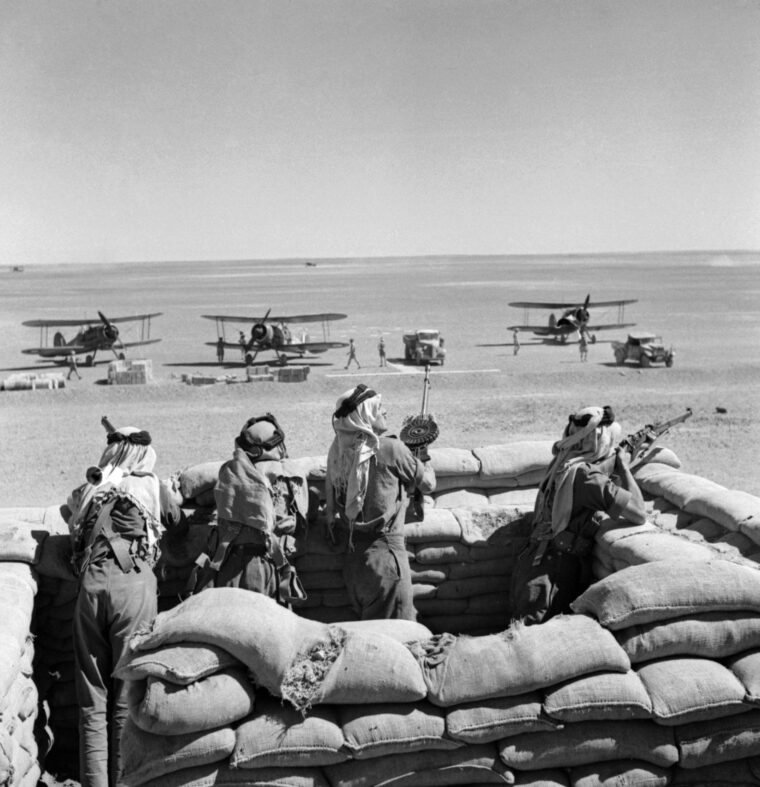 In an audience with the Emir Abdullah, Glubb was asked to pledge his word that as long as he held that appointment, he would always act as if he has been born a Transjordanian. However, he was assured that in the event of there being any fighting with the British, he would be excused this condition and asked to step aside. He gave this pledge freely.
When war broke out in Europe in September 1939, Glubb was not only Commander of the Arab Legion but also Director of Public Security. In 1937, the Desert Patrol had been partially mechanised, raising the Bedouin content of the Arab Legion to about 30%. During those two years Glubb had transformed the Desert Patrol from a para-military into a military force.
In 1941, when a German inspired revolt in Iraq besieged the RAF headquarters in Habbaniya, a British column, escorted by the Arab Legion, was hastily sent along the Haifa-Baghdad road. By the time Baghdad was relieved, the Legion was accepted as both battle-worthy and trusted.
Lebanon and Syria were nominally ‘Free French’ at this time, but with few British troops north of Palestine, this well-armed members of the Arab Legion guard a fleet of British Gloster Gladiator biplanes during the Iraq campaign in World War II. Some 250 legionaries took part in the campaign led the Vichy sympathisers in Damascus to show their true colours. The Legion was swiftly re-called from Baghdad and took part in two battles leading to the defeat of the Vichy forces.
Glubb was awarded the DSO, but to his great regret the Legion saw no further action during the war. It had expanded to 8,000 men but was restricted to far-ranging guard duties in the Middle East, thus freeing British forces for service in Europe. In 1946, he was awarded the CMG.
In 1946, after the war was over, the Emir proclaimed himself King of Jordan. However, by 1948, with reduced funding from Britain, the strength of the Legion had been reduced to 4,000. At the same time, the end of the League of Nations Mandate in Palestine led to increasing tension between the Jews in Israel and their neighbours all round. Glubb endeavoured to sound notes of caution but, because of his British nationality and his primary allegiance to Jordan, was regarded with an element of suspicion by many of the players in this widespread political struggle. Clearly, however, he was trying to find a middle way that might suit Arab, Jewish and British interests in Palestine.
In all his years in the Middle East, Glubb had never feared for his personal safety, with no guards on his house and no escort when on his travels. But, inevitably, he was becoming something of a political target due to his involvement in the Palestine situation. But, in 1951, two events occurred which ultimately led to personal disaster. Trouble erupted in Egypt and King Abdullah was assassinated in Jerusalem. Arab officers began to question why Israeli raids on frontier villages went unpunished – a veiled suggestion that Glubb was not acting even-handedly and that he was tacitly supporting Israel. Despite all these problems, Glubb continued to help Bedouin families who wanted to give up their nomadic life and to settle on hitherto unoccupied land. But the momentum against him was growing and a number of political moves stimulated by pressure from Egypt and Russia, led to his sudden dismissal in March 1956. This was followed by the unilateral abrogation of the Anglo–Jordanian Treaty in 1957. He bore no rancour for his dismissal, just a deep sadness that it was done in such a discourteous way, giving him no opportunity to say goodbye to his many friends.
Although now nearly 59, he had made little provision for his ultimate retirement and suffered financial hardship in his declining years. He was awarded the KCB and managed to keep himself and his family by writing many books and doing many lecture tours, particularly in the United States. To the end, although a committed Christian, he remained devoted to the Arab cause, despite his harsh treatment in 1956 by the Hashemite monarchy. He died on 17 March 1986, aged 88.
Despite widespread apprehension, including that of Glubb himself, that the Arab Legion would go downhill after his departure, this did not turn out to be the case. Now the Jordanian Armed Forces, it is well trained and led, and is certainly far better equipped.
In April 1993, a service was held in the parish church of Mayfield, in Sussex, for the dedication of a memorial window to Lt Gen. Sir John Bagot Glubb kcb cmg dso obe mc. Among the congregation were King Hussain of Jordan and Queen Noor. King Hussain gave an address at the service, which is reproduced below from the Royal Engineers Journal. A portrait of Glubb Pasha hangs in the Royal Engineers Officers Mess in Chatham and many of his medals and honours are on display in the Royal Engineers Museum.
A EULOGY OF A MEMORABLE MAN
Editor’s Note: His Majesty, King Hussain of Jordan, kindly gave permission for his own words, used at the memorial service for Lieutenant General Sir John Glubb to be published in the Royal Engineers Journal.
The memorial service which we are commemorating today in honour of the late John Bagot Glubb echoes with special resonance and depth in my heart, as well as the hearts and minds of my countrymen. Rarely has a man left such a profound imprint upon a people as has General Glubb, better known in Jordan as Glubb Pasha, in recognition of the singularly meritorious ser¬vices which he rendered devotedly, and with the greatest integrity and fullest dedication, in the service of my country.
A soldier, a statesman, a public figure and author of remarkable qualities, he belonged to a unique generation of outstanding men who dedicated their entire lives to the establishment of a genuine understanding, deep friendship and mutual respect between the United Kingdom and the Hashemite Kingdom of Jordan, which have since not only survived the turbulence and vicissitudes of a dazzling changing world, but which have grown into an exemplary relationship between friendly states in every way. Sir John Bagot Glubb became so immersed in the innermost lives and concerns of my people, the humble and the exalted alike, that I wondered often times and without any refection, on his ultimate love and loyalty to his own mother country, where his heart and life dwelt and identified after so many years of service and association with Jordan.
His love and understanding of my country and its people were profoundly heartfelt and over-whelmingly affectionate. Unlike some other flamboyant arabists, he disdained publicity which inevitably embellishes men of his stature. The legendary image which subsequently became associated with his name was, in my considered opinion, neither of his choice nor even to his liking.
He was a down to earth soldier, with a heart, a simple style of life and impeccable integrity, who performed quietly and unassumingly, the duties entrusted to him by his second country Jordan, at a crucial moment in its history and development. He contributed immeasurably to the enhancement of the disciplined, martial, and professional traditions of the Jordanian Arab Army in its early formative years, an accomplishment recognised since World War II by friend and foe alike. I am sure that few would have been happier than he himself to have seen this valiant army, whose small nucleus he dedicated himself to build on the most solid foundations of honour, courage and professionalism, grow and expand to its full flowering and maturity over the past quarter of a century since his retirement from its service.
When General John Bagot Glubb retired from active service in 1956, the winds of change and transformation were sweeping the entire Middle East, including Jordan, with hurricane force. In normal circumstances his retirement from service, after a long career, should have been the most natural of events, as in all countries in the world. But, regrettably, the retirement of such a distinguished General became embroiled in the whirlwind of international politics which had then enmeshed the region of the Middle East and rendered it a centre of crises.
General Glubb, to whose memory we pay homage today, was fully cognizant of the imperatives of change. He retired with full understanding and no rancour in his warm heart, but with sadness for the end of an era which he passionately loved. He spent his long years of retirement writing books and articles singing the praises of Jordan and its valiant Army. He matched his services to his beloved Arab Legion and to Jordan with equally dedicated efforts to propagate its cause, as was only to be expected from a man of his stature, principles and intellectual integrity.
On this solemn occasion, I wish to pay the highest tribute to the man, the friend, the adviser, the legend we are honouring today, a tribute shared by all those who knew him and mourned his passing away. Our condolences go to his bereaved family and his life-long friends.
May God bless his soul and may he rest in peace, which he so richly earned in life, and abun¬dantly deserves in the afterlife. His memory will live in our hearts and his name will always be associated with the loftiest qualities a man could be endowed with in his lifetime.
A portrait of Glubb Pasha byA C Davidson-Houston, in 1960, shown in the uniform and head-dress of the Jordanian Army (The Arab Legion) that hangs in the RE HQ Mess in Chatham.