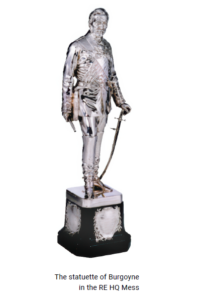
Field Marshall Sir John Fox Burgoyne GCB BT
Born on 24 July 1782, eldest of the four illegitimate children of Lieutenant General John Burgoyne and the singer Susan Caulfield, John Fox Burgoyne was educated at Eton, entered the Royal Military Academy in Woolwich in 19 October 1796 and was commissioned into the Royal Engineers on 29 August 1798 at the age of sixteen. In 1800, he took part in the expedition to the Mediterranean and 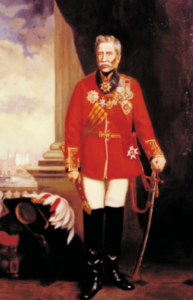 was actively involved in the blockade and subsequent capture of Malta which, after stubborn French resistance, placed this important citadel in British hands. He was promoted to lieutenant on 1 July 1800 and second captain on 1 March 1805. Actions in Sweden, Sicily and Egypt between 1805 and 1807 brought him recognition and a Mention in Despatches, which enhanced a growing reputation for ability, zeal and professional skill. A return to Sicily, under Sir John Moore, was followed by a transfer to Portugal in 1808 for the entire campaign in the Peninsula. He was promoted captain on 24 June 1809. During the retreat to Lisbon, as the French army advanced, his skills and judgement were illustrated when he was responsible for the demolition of two bridges. Timing was vital, as was coolness, nerve and professional skill; both operations were completely successful. He next joined Sir Arthur Wellesley in Spain and was involved in every siege and major battle throughout the Peninsular war. These included the Battle of Busaco (27 September 1810), the second siege of Badajoz (May – June 1811) and the capture of Ciudad Rodrigo (8 – 19 January 1812). He obtained a brevet majority on 6 February 1812 and served at the successful third siege of Badajoz (March – April 1812), becoming a brevet lieutenant colonel on 27 April. Sieges offered limited scope for true military engineering and were usually ended by frontal assaults, but his reputation continued to grow and he was held in high regard.
Burgoyne was commanding engineer at the capture of the forts of Salamanca and subsequent battle (July 1812), the following month with Wellington at Madrid, and during the unsuccessful siege of Burgos (September – October 1812), where he was twice wounded. At Vitoria (21 June 1813) he served with the 3rd Division, having a horse wounded under him in three places. From Pamplona he went to San Sebastian, where (July – August 1813) he became joint director of the attack. Severely wounded in neck and jaw, he nevertheless took over as commanding engineer when Lieutenant Colonel Sir Richard Fletcher fell. In the latter stages of the Peninsular War Burgoyne acted as commanding engineer at the crossing of the Bidassoa (7 October 1813), the passage of the Adour, and the blockade of Bayonne (February 1814). He was promoted to lieutenant colonel on 20 December 1814. Only a few months after the end of the Peninsular war, Burgoyne participated as Commanding Engineer in the attack on New Orleans and at the close of hostilities in America returned to England in 1815. He was disappointed when not sent to the Netherlands but by the time he had managed to have this decision reversed, he arrived there too late for the battle of Waterloo.
From 1815 to 1818, he was Commanding Royal Engineer in the army of occupation in France, followed by eight years as CRE (Chief Royal Engineer) of the Medway District. In 1826, Burgoyne was appointed Commanding Engineer of a force sent to Portugal to deter a possible Spanish invasion. Nothing came of this threat and he returned home in 1828. This led to an appointment as CRE Portsmouth, a post which he held for three years. He was promoted to brevet colonel on 22 July 1830. In February 1831 he visited Brighton where he met King William IV, who sought his advice on various aspects of the defences and fortifications on the south coast. In 1831, he was offered, and accepted, the post of Chairman of a Board of Public Works to be established in Ireland, an appointment which he held for some fourteen years. While in this post, Burgoyne produced a pamphlet, Letters on the State of Ireland, which perceptively forecast problems over the established church and excessive powers of landlords. More radically, in 1834, to the duke of Richmond’s royal commission on the feasibility of administrative consolidation, he advocated ‘uniting in one person the offices of Secretary at War, Commander-in-Chief and Master-General of the Ordnance under the title of Secretary of State for the War Department’. Burgoyne became colonel in the Royal Engineers (10 January 1837) and major general (28 June 1838) and was appointed KCB on 19 July 1838. In 1839, he was elected an honorary member of the Institution of Civil Engineers but failed to secure appointment as under-secretary of state for Ireland in May 1840. However, although a civilian post, he managed to retain his military seniority and, in 1845, was appointed Inspector General of fortifications. His strong report to the Duke of Wellington on the inadequacies of British coastal defences produced positive results and funds were voted by Parliament for making good the deficiencies and omissions of previous years. 1847 saw Burgoyne back in Ireland with a brief to organise and conduct the Commission for the relief of the distress being caused by the famine. Clearly, he had great aptitude for this type of project and willingly became involved in others, despite the fact that none offered the same sort of challenge as had the many sieges and military operations in which he had been involved over the years.
When, in the winter of 1853 – 1854, it became evident that Russia posed a threat to the peace of Europe, he was sent to Constantinople to report on the measures he considered necessary for the defence of that area. By now he was 71, an astonishing age for such a task, but another clear indication of the respect which he commanded in government circles. Despite his age, however, he was appointed Lieutenant General on the staff of the Army in the East and was fully involved in the strategies and operational planning of the opening phases of the Crimean war. Lord Raglan acknowledged freely just how much he was indebted to Burgoyne for the advice and assistance given at the battle of the Alma (where Burgoyne’s horse was wounded). The same happened at Inkerman and Lord Raglan proposed his promotion to General. However, he was recalled to England before the end of the Crimea conflict and did not receive as much credit for his contribution as he might have done had he been allowed to stay. Lord Panmure, the then Secretary of State for War, denied that Burgoyne was a political scapegoat as Raglan’s staff had been severely criticized in the press and parliament for incompetence. Having been Knighted (KCB) in 1838, Burgoyne was offered a GCB in 1852. However, despite having served the Crown for 54 years – and by then aged 70 – he felt that he just could not afford the expense which this honour would involve, without diluting his wife’s future pension, assuming that she outlived him. He was anxious not to show disrespect for the Crown but declined the honour. Nevertheless, his point was well taken, adjustments were made and the honour was subsequently accepted. He was appointed Colonel Commandant of the Royal Engineers on 22 November 1854. Following the fall of Sebastopol, Burgoyne’s promotion to General was confirmed on 5 September 1855 and he was created a Baronet. Various other honours and awards, both British and foreign, followed. Queen Victoria appointed him a Field Marshal in 1868 and the Lord Mayor and Aldermen of London awarded him the Freedom of the City in a casket of gold.
In 1865, he had been appointed Constable of the Tower of London and, in 1868, on his retirement as Director General of Fortifications, he was granted a pension of £1,500 per year to mark the ‘value of his services’. By then aged 86, he still enjoyed good health but two years later tragedy struck. His only son, Captain Hugh Talbot Burgoyne RN, one of the first recipients of the Victoria Cross, died at sea in 1870. His death, without issue, ultimately caused his fathers title to become extinct. Field Marshal Sir John Burgoyne never recovered from this terrible loss and died peacefully on 7 October 1871, aged 89. In his funeral oration, the Reverend G R Gleig described Burgoyne as ‘brave, able, intelligent, upright, a humble Christian, a modest citizen’. Wellington had previously observed: ‘If Burgoyne only knew his own value, no one would equal him’; his biographer attributed ‘timidity of manner and distrust of his own powers’ to diffidence at family poverty after his father’s death. Nevertheless, Napoleon III wrote to Burgoyne in 1870, following his own defeat by the Prussians:
‘You are the Moltke of England’.