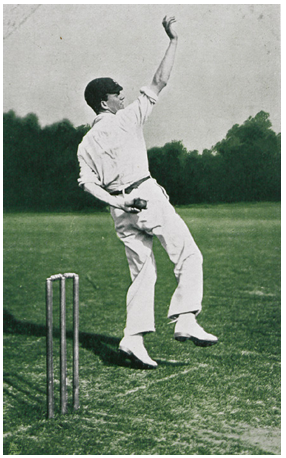
Serjeant Colin ‘Charlie’ Blythe (1879 – 1917)
On 14th March 1910, playing in just his 19th test, Colin ‘Charlie’ Blythe took his hundredth wicket for England. 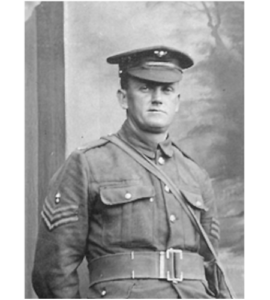
In the history of the game, only two other English players have achieved this feat in fewer matches. Placing equal third alongside Ian Botham, Blythe sits in august company. What’s more, his match figures of 17-48 for Kent against Northamptonshire, taken in a single day in 1907, remains the best bowling analysis ever achieved in county cricket. In the first innings of that match, he took all 10 opposition wickets.
Born in Deptford, Kent, in 1879, Blythe was the eldest of 13 children. On leaving school he followed in his father’s footsteps by becoming an apprentice fitter at the Royal Arsenal at Woolwich. Surprisingly, his cricketing prowess was only discovered by chance, and relatively late, when he went to watch Kent play Somerset as an eighteen -year-old. Walking past the nets, he was asked to bowl a few warm-up balls to one of the Kent players and was immediately offered a trial. On his first-class debut for Kent in 1899, he took a wicket with his very first ball.
In his first full season for the county, Blythe took over a hundred wickets – a feat he would repeat every year between 1902 and 1914 on the way to amassing a career total of 2,503 first class wickets. With a smooth, classical action and looping flight, he was considered one of the finest slow left-arm bowlers of the era. Had he not suffered from epilepsy, which was exacerbated by the stress of big games and which left him incapacitated for days afterwards, he would undoubtedly have played many more times for England. As it was, his 19 tests between 1901 and 1910 included nine 5-wicket innings and four 10-wicket matches, his best figures of 15 for 99 coming against South Africa at Headingly in 1907. Only seven English players have bettered his final test bowling average of 18.63 runs per wicket.
When war was declared on 4th August 1914, the county championship season was abandoned, WG Grace proclaiming it wasn’t fitting that ‘able-bodied men should be playing day after day, and pleasure seekers look on’. The so-called Golden Era of English cricket had come to an abrupt end. Blythe and several other Kent cricketers immediately enlisted into the Kent Fortress Engineers (KFE), a territorial works unit with companies spread across the county. Stationed in Gillingham for the first two years of the war, Blythe rose to the rank of sergeant. In 1916, the Conscription Act made territorial forces liable for overseas service and, in early 1917, the KFE were mobilised for deployment to France to reinforce the Kings Own Yorkshire Light Infantry. Blythe had not been included in the original list of those detailed for service in France but he offered to relinquish his stripes to avoid being left behind. The death of his brother on the Somme the year before was undoubtedly a factor in his determination to deploy. Retaining his rank, he was one of 277 soldiers from the KFE who went to the Western Front that year.
Whilst there was no county or test cricket played during the Great War, in the summer of 1917 Lord’s hosted two international charity matches. On 14th July the Army played the Australian Imperial Forces and, on 18th August, the Army & Navy took the field against a combined team from the Australian & South African Forces. Blythe played in both matches. It was the last time he would grace a cricket field.
On 8th November 1917, while attached to the 12th Pioneer Battalion of the Kings Own York shire Light Infantry at Passchendaele, Blythe was supervising the laying and maintenance of tracks on the light railways used to facilitate the movement of troops and supplies behind the British lines. A stray shell exploded above the working party he was leading and the shrapnel pierced his chest. He died instantly. Blythe was 38 and had announced his retirement from first class cricket, having accepted a coaching position at Eton. He was one of 21 test cricketers killed during the First World War.
Serjeant Blythe is buried in the Oxford Road Cemetery at Wieltje, near Ypres (Grave reference:I.L.2).. When the England cricket team visited Flanders ahead of the 2009 Ashes series, skipper Andrew Strauss laid a stone cricket ball alongside his grave. There is a memorial in Blythe’s honour at the St Lawrence Cricket Ground in Canterbury, where his shrapnel-damaged wallet is on display in a glass case, and in Tonbridge there is a road named after him.
Assessing Blythe’s standing in the pantheon of all-time cricket greats is difficult. His name does not echo down the years in the same way it does for his Yorkshire contemporary, Wilfred Rhodes, for example. But, between 1906 and 1914, Blythe was widely regarded as the best bowler in the land. For four seasons over this period he was the leading wicket taker in the first-class game and his bowling was crucial to Kent’s emergence as an elite county side. They won the County Championship for the first time in 1906, then three times after that before the outbreak of war.
Blythe’s statistics alone put him up there with the cricketing greats of the Edwardian era, a period which saw the game reach new heights of popularity. Furthermore, when one considers the heath challenges he had to overcome, at a time when epilepsy was neither well understood nor discussed openly, the scale of his achievements seems even more remarkable.