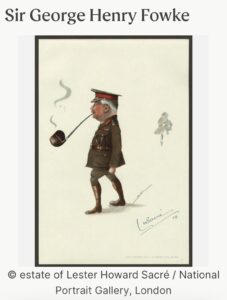
Lieutenant General Sir George Fowke KCB KCMG
George Henry Fowke was born on 10 September 1864, the youngest son of William Villiers Fowke of Saling Grove, Essex. Part of his childhood was spent in Florence, an experience that left him fluent in modern languages and shaped a lifelong intellectual curiosity. Educated at Wellington College, he entered the Royal Military Academy and was commissioned into the Royal Engineers in February 1884. 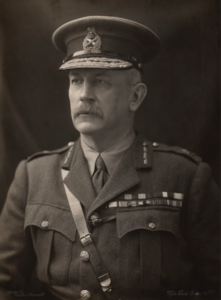
From the outset, Fowke stood out for his intellect and personality. He possessed an exceptional memory, read voraciously, and passed professional examinations with ease — so much so that he acquired an undeserved reputation for laziness. In reality, he was quietly rigorous. Recognising gaps in his mathematical training after gaining his commission, he deliberately rebuilt his knowledge from first principles until he had mastered every branch relevant to his profession. Social, energetic, and quick to laugh, he had an instinctive ability to draw people to him.
At the Royal Military Academy and the School of Military Engineering, sport played a central role in his life. He captained the rugby team, represented the Corps at cricket (valued more for his tireless fielding than his batting) and found particular enjoyment in racquets. Physical energy and competition were constants throughout his career.
His first overseas posting was Gibraltar in the late 1880s, where the Royal Engineers were strong enough to parade as a battalion. As Adjutant, Fowke became a familiar figure on ceremonial duties, noted for his presence, vitality, and relentless enthusiasm. By 1891, still a young captain, he was selected to oversee the reconstruction of the Curragh Camp in Ireland, a sprawling and outdated installation originally built after the Crimean War. The task occupied him for seven years and proved decisive in shaping his career. He approached the work with characteristic intensity, demonstrating that technical and administrative engineering work could be as vital—and as demanding—as service in the field. Despite the scale of his responsibilities at the Curragh, Fowke remained the driving force of the Royal Engineers’ social and sporting life. When the work was completed in 1897, he returned to Aldershot to command the 26th Field Company, later transferring to the 23rd Field Company as it prepared for deployment to South Africa. Arriving in time to be trapped in the siege of Ladysmith, Fowke quickly found himself at the centre of operations. In December 1899, he co-led a night raid to destroy two Boer artillery pieces on Gun Hill that had been inflicting heavy pressure on the garrison. The operation was executed with precision and daring, becoming one of the most celebrated engineering exploits of the siege. Fowke was mentioned in dispatches and later promoted brevet major.
Explosives fascinated him throughout his life, and he became one of the Army’s acknowledged experts in their use. After the siege, he continued campaigning in the Transvaal and contributed to the development of blockhouse systems that played a key role in ending the war. In 1901, following the British annexation of the Transvaal, he was appointed Town Engineer of Pretoria. What followed was one of Fowke’s most enduring achievements. Starting almost from nothing, he built a Public Works Department capable of repairing and reconstructing war-damaged government infrastructure across vast distances. He recruited widely, often from outside the civil service, and shaped a disparate group of engineers into a disciplined, trusted organization. Under his leadership, the department expanded and eventually became the foundation of the Public Works Department of the Union of South Africa. His emphasis on efficiency, honesty, and personal responsibility left a lasting institutional legacy.
After returning to Britain in 1904, Fowke joined the British Military Mission to Manchuria during the Russo-Japanese War. He observed modern siege warfare at first hand and was decorated by the Japanese government. Back home, he applied these lessons as Chief Instructor in Fortification, running large-scale and highly realistic siege exercises that reflected what he had learned abroad. By the outbreak of the First World War, Fowke had served at Aldershot and in senior posts at the War Office and was widely known across the Royal Engineers. He landed in France in August 1914 and was initially appointed Engineer Adviser at General Headquarters—a role with little authority, minimal staff, and vague responsibilities. The reality of industrial warfare quickly transformed the position. Fowke grasped almost immediately that his central task was not technical problem-solving but organization on an unprecedented scale. He expanded divisional and corps engineering staffs and responded rapidly to the unexpected threat of enemy mining. Working alongside the civilian engineer Sir John Norton Griffiths, he helped create the first British tunnelling companies. Their success led to the rapid formation of specialist units for camouflage, forestry, gas defence, water supply, and drainage.
Adaptable, calm, and open to unfamiliar ideas, Fowke became the quiet architect of Britain’s engineering war effort in France. Although personally reluctant to accept titles or attention, he eventually assumed the historic designation of Engineer-in-Chief. His office became a clearing house for advice on problems far beyond engineering, simply because his judgment was trusted.
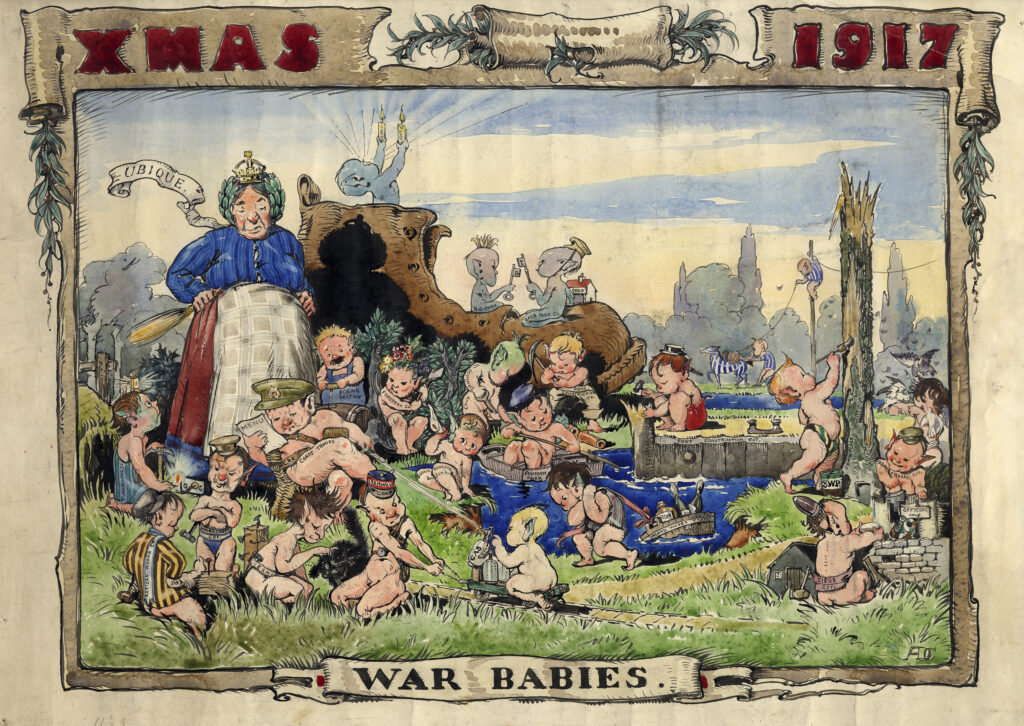
His greatness was immortalized in the Christmas Card for I9I7, drawn by the artists of the Camouflage School, entitled ‘War Babies’ and dedicated to the E-in-C. Fowke was very proud of this tribute from his staff.
In February 1916, he was appointed Adjutant General of the British Expeditionary Force, with the rank of Lieutenant General. His tenure was marked by empathy, administrative skill, and an ability to navigate the complex manpower challenges of total war. Colleagues consistently praised his understanding and fairness. Despite his effectiveness, Fowke’s lack of formal staff college training and field command left no clear path for further advancement. He retired in 1922 at the age of 58, a decision widely regarded as a loss to the Army.
He spent his remaining years in contented retirement at Dinard, where he died suddenly on 8 February 1936. During his lifetime he received numerous British and foreign honours, including the KCB, KCMG, the Legion of Honour, the Belgian Croix de Guerre, and the American Distinguished Service Medal. He was appointed Colonel Commandant of the Royal Engineers in 1921.
Fowke immortalized in a cartoon by Lester Howard Sacré – The National Portrait Gallery