Major General Sir Ernest Dunlop Swinton KBE CB DSO
To most Sappers, Swinton is associated with the eponymous barracks at Perham Down, Tidworth, home to 22 and 26 Engineer Regiments. The name is fitting, as Major General Sir Ernest Swinton KBE CB DSO was a principal pioneer of the tank and a central figure in the development of armoured engineering within the Corps of Royal Engineers. Despite this, he remains relatively overlooked compared with more celebrated Sapper figures such as Gordon or Kitchener.
During the early stages of the First World War, Swinton championed the concept of an armoured, motorised vehicle running on caterpillar tracks to support infantry assaults by crossing trenches, crushing wire and neutralising enemy machine-gun positions. He named the vehicle the ‘tank’, developed its tactical employment, and trained the first crews that entered combat on 15 September 1916 at Flers-Courcelette on the Somme.
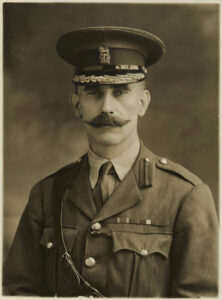
Swinton’s contribution not only marks the emergence of the most significant military invention of the First World War – one that later revolutionised land warfare – but also provides a powerful example of overcoming institutional resistance to innovation. A truly great Sapper, he deserves greater recognition today. Before the First World War Ernest Dunlop Swinton was born on 21 October 1868 in Bangalore, India, the son of a British civil servant. Educated in England at several schools including Rugby and Cheltenham, he proved academically capable and athletically inclined. A formative experience came in 1884 during a summer in Bonn, where he learned German and developed an early interest in continental affairs. Swinton entered the Royal Military Academy, Woolwich, in 1886, ranking eighth and securing one of only fifteen commissions into the Royal Engineers. Commissioned in 1888, he later recalled his two years at the School of Military Engineering in Chatham as among the happiest of his life, combining rigorous technical training with sport and social life. In 1890 he was posted to India, serving as a junior military works officer near Lucknow. There he undertook routine RE duties, sports, and hunting, while also displaying a sharp wit and independence of mind, particularly when dealing with senior officers. Returning home in 1896, Swinton became an assistant instructor in fortification at Chatham. During the Second Boer War he served in South Africa, initially with the military railway staff and later commanding the Railway Pioneer Regiment. His work maintaining and protecting vital rail communications brought him into frequent conflict with rigid military bureaucracy, deepening his dislike of institutional resistance to practical innovation. He was awarded the Distinguished Service Order in 1901.
Swinton’s most enduring legacy from this period was The Defence of Duffer’s Drift (1903), a fictional but instructive study of small-unit tactics that promoted critical thinking and remains a military classic, still widely read by British and American forces. It was written under the pseudonym, ‘Lieutenant Backsight-Forethought’. Promoted to major in 1906, he became chief instructor at Woolwich, where he wrote extensively on modern warfare, advocating new technologies such as quick-firing artillery, aerial observation, and mechanisation. Between 1910 and 1914, Swinton’s experiences including study of the Russo-Japanese War, travel in Germany, and work in the Historical Section of the Committee of Imperial Defence confirmed him as a forward-thinking officer. By the outbreak of the First World War, he was a prominent military writer and a strong advocate of technological innovation, well prepared for his later role in the development of the tank.
Early Advocacy for the ‘Tank’
At the outbreak of the First World War in August 1914, Ernest Swinton was appointed temporary lieutenant colonel and Deputy Director of Railways for the British Expeditionary Force (BEF) in France and Belgium. His tenure was brief. Lord Kitchener, concerned about inaccurate press reporting and aware of Swinton’s literary skill, appointed him an official war correspondent. Writing under the pen name ‘Eyewitness’, Swinton produced 103 articles up to July 1915. Granted wide access to the front, he witnessed the emergence of trench warfare dominated by barbed wire and machine guns, a stalemate that deeply concerned him. Swinton applied his mind to breaking this deadlock. His memoirs reveal pioneering work in psychological operations; as early as October 1914, he arranged for 25,000 leaflets to be dropped over German lines. The idea was rejected by military authorities, who failed to see its value. More significantly, Swinton proposed the use of armoured, tracked tractors to crush wire and neutralise machine guns. He discussed this with Colonel Maurice Hankey in October 1914 and Hankey circulated a paper based on Swinton’s ideas in December. Progress stalled until Winston Churchill, First Lord of the Admiralty, took an interest. Churchill, seeking a mechanical solution to trench warfare, agreed that machine-gun fire could only be defeated by mechanical means. On 5 January 1915, he urged Prime Minister Asquith to pursue caterpillar-tracked machines capable of crossing trenches, destroying wire, and sweeping enemy positions. With Asquith’s support and Kitchener’s nominal approval, the matter was referred to the War Office, which remained sceptical and indecisive. In parallel, Churchill established the Landships Committee in February 1915 under Eustace Tennyson-d’Eyncourt. Acting largely on his own authority, Churchill ordered prototypes and accepted personal responsibility for the expenditure. The War Office, however, remained lukewarm and even sought external advice on whether anyone could design such a vehicle. Meanwhile, Swinton independently pressed his case. In January 1915, he raised his ideas with senior Royal Engineers officers but was told that the War Office would not initiate proposals without a request from GHQ. Despite further setbacks, his observations at failed offensives such as Neuve Chapelle, Aubers Ridge, and Festubert reinforced his conviction that machine guns and wire dominated the battlefield. In June 1915, Swinton submitted a seminal memorandum, ‘The Necessity for Machine Gun Destroyers’, to the BEF Commander-in-Chief, Sir John French. It outlined the operational role, technical specifications and principles of employment for tracked, armoured vehicles armed with machine guns and light artillery, stressing the importance of surprise and massed use. French endorsed the proposal and forwarded it to the War Office, noting that Admiralty experiments were already under way. Chance further favoured Swinton when he accompanied Asquith and Kitchener on a tour of the Western Front in July 1915. Shortly afterwards he was recalled to London, nominally to deputise for Hankey, but also to press the tank project from a central position.
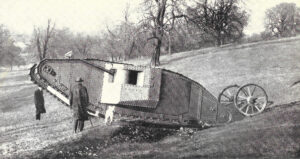 With new authority, Swinton quickly linked up with the Landships Committee, where Lieutenant Albert Stern drove the project forward. Working with engineer William Tritton and naval architect Walter Wilson, Stern oversaw the creation of the first practical tank prototypes. By December 1915 an initial order for 50 machines was approved, and Swinton coined the deliberately bland name ‘tank’ for security. In early 1916 the rhomboidal prototype ‘Mother’ was ready for trials, marking the successful culmination of efforts begun amid the stalemate of 1914.
Photograph Of The Original Tank, ‘Mother’, afterwards known as the Mark I Tank
Kitchener instructed that the new armoured machine be tested immediately. By 20 January 1916, the prototype tank, later known as Mother, had completed preliminary trials. Under strict secrecy it was transported to Hatfield Park, where Swinton helped design a test course replicating German trench systems, including shell craters and wire. The official trial on 2 February 1916 was attended by Kitchener, Lloyd George, General Robertson and representatives from GHQ. The machine crossed a nine-foot trench with ease and impressed most observers, though Kitchener dismissed it as a ‘pretty mechanical toy’. Despite his scepticism, he did not block the project. Support soon followed from other quarters. GHQ representatives recommended adoption and King George V personally observed a private demonstration on 8 February, expressing his approval. Shortly afterwards, GHQ ordered 40 machines, which Swinton urged be increased. By April 1916, the order had risen to 150 tanks, built by firms in Lincoln and Birmingham. Two variants emerged: ‘male’ tanks armed with 6-pounder guns and ‘female’ tanks armed solely with machine guns. Swinton then focused on ensuring effective battlefield employment. He produced a major doctrinal paper, Notes on the Employment of “Tanks”, outlining their capabilities, limitations, and integration with infantry, artillery, and aircraft. He stressed that tanks were auxiliary weapons, intended to overcome wire and machine guns in support of infantry rather than win battles alone. His emphasis on coordination across arms marked an early appreciation of combined-arms warfare.
Organisational changes followed. The Tank Supply Committee, chaired by Albert Stern and subordinated to the Ministry of Munitions, was empowered to oversee manufacture with minimal bureaucracy. Swinton was tasked with raising and training the first tank unit. Appointed Temporary Colonel in March 1916, he formed the Tank Detachment – soon renamed the Heavy Section of the Machine Gun Corps – drawing heavily on mechanically skilled personnel. Training began at Bisley before relocating to a purpose-built facility at Elveden, Suffolk, where crews trained on a simulated battlefield while experimenting with communications and camouflage. As production continued, pressure mounted to deploy tanks during the Somme offensive. Swinton and Hankey warned against premature use but limited numbers were sent to France. On 15 September 1916 tanks were first used at Flers-Courcelette. Mechanical unreliability reduced their impact, yet some achieved striking local successes, notably in the capture of Flers village. Haig judged their performance promising and quickly demanded more, leading to an order for a further 1,000 tanks.
Although Swinton later criticised the premature loss of surprise, the tank’s potential was then recognised. By late 1916, his direct involvement ended; command passed to Hugh Elles, and Swinton returned to government service. Nonetheless, his influence on the conception, organization, and doctrine of armoured warfare had already proved decisive.
Swinton’s Subsequent Career
In September 1917, Swinton travelled to the United States as a staff officer to Lord Reading’s mission, accompanying him again in February 1918. The second visit became a six-month speaking tour on behalf of the US State Department in support of the Third Liberty Loan. After the armistice he worked at the Ministry of Labour as controller of information and publicity, attempting to coordinate press communications during the difficult demobilization period. He retired from the army in 1919 with the rank of major general. From 1919 to 1921, Swinton served as controller of information in the civil aviation department of the Air Ministry, promoting public interest in aviation. In 1922, he became a director of Citroën-Kégresse Cars Ltd, remaining closely involved with the firm’s innovative half-track vehicles for the rest of his life. Appointed KBE in 1923, he also assisted Lloyd George between 1921 and 1924 during preparations for the latter’s war memoirs, though he refused to ghostwrite them. His election in 1925 to the Chichele Chair of Military History and a fellowship at All Souls College, Oxford, marked his return to academic life, a post he held until 1939.
Swinton remained preoccupied with the First World War, asserting his role in the tank’s development in Eyewitness (1932). He served as colonel-commandant of the Royal Tank Corps from 1934 to 1938 and broadcast wartime commentaries in 1940. He died in Oxford on 15 January 1951.
This article is based on the thorough account of Swinton’s life and contribution by Major General Mungo Melvin cbe obe finstre in the August 2025 edition of the Royal Engineers Journal, which can be accessed here: Ernest Swinton, the Sapper and the Advent of the Tank.