Field Marshal Lord Kitchener
Field Marshal Earl Kitchener of Khartoum was so much more than the recruiting poster-boy for First World War. He was the designer of the Imperial Continental Army that went on to win the war. Creating this army from a standing start was a far greater achievement than raising the Second World War armies as, by then, it had been done before, there was an early decision before the war to double the size of the TA and there was a phoney war period to assist with preparations. 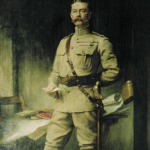 Kitchener alone seemed to understand just how long the war was likely to last and how many men would be required. In his biography, Warner reports that he told his Cabinet colleagues that if the British had had a million trained men at their disposal, the Germans would never have dared to risk a war but, that now it had begun, it would require far more than one million and, in fact, would only be won with the last million which would be thrown into the conflict. But Kitchener’s contribution to his country was greater than this and he was invited to be Secretary of State for War precisely because he was already a household name that carried the confidence of the nation at large. This had been earned throughout his career and, most particularly, from his time in Egypt and South Africa.
His Career before the First World War.
His career started as many Sappers of his generation did with a sound education in military engineering and surveying. His earliest posting was to command C Telegraph Troop in 1873, but he was soon seconded to the Survey of Palestine, which he eventually led, on behalf of the Palestine Exploration Fund. Although the aim was to survey the various biblical sites, the War Office supported this endeavour as knowledge of the military geography could be of great value. By that time in his life, Kitchener had developed a deep religious belief; he also embraced the growing technology of photography and published a volume of photographs of biblical sites with a commentary. He was elected a Fellow of the Royal Geographical Society at this time as a result of this work.
He came to prominence, having largely completed the survey of Cyprus and reorganized its Land Registry Office over a period of 3 years, by getting involved in the Egyptian crisis of 1881. By then he had become an accomplished horseman, winning races on the flat and over fences.
Kitchener had bought a bear cub during an 8-month tour to Anatolia and kept it as a pet in Cyprus, in the house he shared with another officer. He also grew his characteristic moustache at that time, which was to remain something of a hallmark, although not so uncommon at the end of the nineteenth century. As he was not invited to join the mission to put down the Arabi revolt in 1882 despite being a fluent Arabic speaker, he took a week’s leave and headed to Alexandria, where he offered himself as able to spy on the Arabi positions. From the contacts made during that period, he was invited to become Second-in-Command of an Egyptian Cavalry Regiment, a very rare appointment for a Sapper. Thus began a long association with the country, leading eventually to the great success at the Battle of Omdurman. He was involved in the Gordon Relief Expedition of 1884 – 85, as head of intelligence but the expedition was too slow and Khartoum was sacked and Gordon killed before relief could arrive. Clearly, he saw this as unfinished business.
Back in UK and with the Royal Engineers as a Brevet Major, he was sent to Dublin to build barracks but was soon requested by the Foreign Office to head up the Boundary Commission in Zanzibar, for which he was awarded the CMG. He was next appointed as the Governor of Eastern Sudan. The area was not peaceful and he saw action, being wounded in the ear and jaw and he was repatriated to recover. His public persona was being cultivated at this time and he came to the attention of the Queen. In 1889, he returned to Cairo as the Adjutant General of the Egyptian Army. He was appointed Brigadier General in 1892 and Commander-in-Chief of the Egyptian Army. He set about increasing its size. The decision to retake the Sudan in 1896 opened the way to the advance on Khartoum. Kitchener understood logistics and engineering and invested time and energy is establishing rail lines of communications along the Nile and cutting the long bend in the river requiring a 250 mile desert route. He recruited Lieutenant Percy Girouard, who had worked on the Canadian Pacific Railway, to oversee the work. By then, Kitchener had established himself as a skilled negotiator, understanding the Egyptian and Arab mindsets. His success at the Battle of Omdurman and the advance on Khartoum were covered extensively in the British press and Kitchener was rewarded by being created Baron Kitchener of Khartoum and appointed Governor General of the new state of Sudan. After a successful two years redeveloping the city and establishing a proper administration, he was sent to South Africa to serve as the Chief of Staff to Lord Roberts. After Roberts departed, Kitchener took over as Commander-in-Chief. Despite Roberts’ claim that the war was won, this was certainly not the case and Kitchener eventually resolved the issue through the construction of thousands of blockhouses, with interlocking fields of fire and, rather more contentiously, by rounding up the farmers and their families from outlying farms, from where they could support the Boers, into secure camps, which were, unfortunately, called concentration camps. The outrage in the British press over the deaths, caused by disease, certainly gave concentration camps a bad name and one that was to echo again through the Second World War. It was certainly unwise to confine some 80,000 people, relying on them to provide their own administration and hygiene.
Although not employed as a military engineer, Kitchener never forgot his roots. When he returned to England on the conclusion of the campaign, he was dined at the Chatham Mess, and in his speech he told those present that, while he was carrying on the war in South Africa, the Prince of Wales (who was to become HM King George V) landed at Durban, on his return voyage from Australia. Lord Kitchener went to Durban to meet him and was greeted by the Prince of Wales with the question, ‘How is it that on landing at Durban I find that the Governor of Natal, Sir Henry Macallum, is an RE, the Prime Minister of Natal, Sir Albert Hime, is an RE, and the C-in-C of the Army of South Africa is an RE’. Lord Kitchener said that he replied to the Prince of Wales by referring him to the Corps motto, Ubique quo Fas et Gloria ducunt.
Kitchener was sent as in the rank of General as Commander-in-Chief of the Indian Army. He set about reforming the Army away from heavily manned garrisons into a Field Army with 2 Divisions that could be sent overseas from India for Imperial Defence. He was then sent on a tour of the Australian and New Zealand Armies, returning via the United States of America. He had developed an understanding of the contribution each country could make to the coming war and had encouraged them to make changes to allow for a more mobilised force. On his return he was made Field Marshal.
The First World War
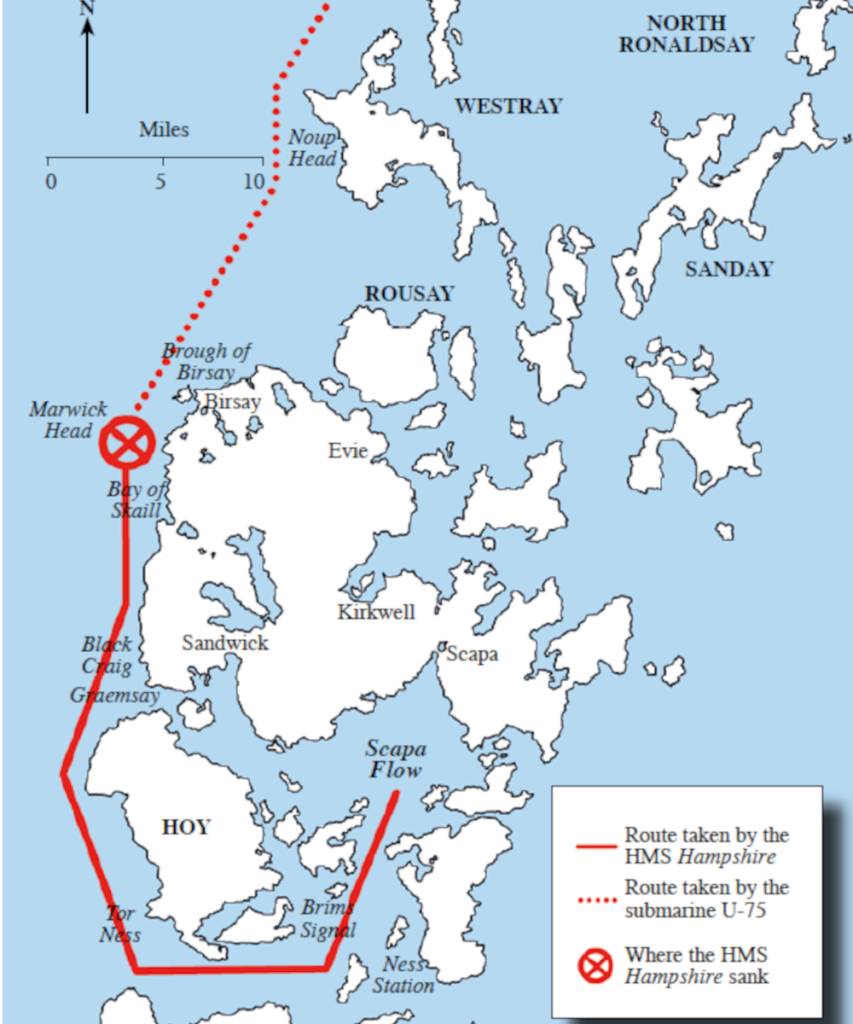
Kitchener happened to be in England when the call came for him to join the Government as Secretary of State for War. He was alone in understanding the enormity of the challenge and alone in having the credibility and public profile to call for volunteers on such a massive scale. He guaranteed the contribution of the Dominions and created the equipment and munitions industries. He was tireless in pursuing the war effort, visiting the front lines, allies and the injured. He was not popular with his fellow politicians but was respected. He clashed, notably, with Lord Esher over the need for a British Expeditionary Force; Esher thought the war would be decided in the first few weeks. However, the tribute paid by Lord Esher after his death was fulsome. Of the controversies surrounding Kitchener’s death and the rather outlandish claims that he didn’t die and was secreted away by the Germans, all are now considered debunked. Jeremy Paxman wrote most convincingly about it in the Financial Times, having reviewed the Government files, released by the National Archive. HMS Hampshire departed Scapa Flow with the Secretary of State onboard for a visit to Russia. The ship hit a mine and sank in very few minutes. Kitchener and his personal staff, including civil servants all perished.