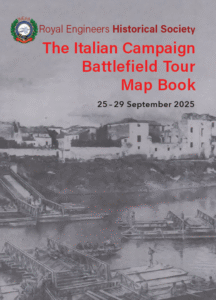
Royal Engineers Historical Society Battlefield Tour - Italy 2025

“The Country: The topography of most of Italy generally gives great advantages for defence or delaying actions. The “toe” is wild and mountainous and would have been difficult to clear had the enemy seriously contested it. The “heel” and the country between Taranto and the Foggia Plain, is mainly flat with good communications and few obstacles; this area was overrun without great difficulty. The Salerno beachhead was a small undulating alluvial plain, with numerous streams and irrigation cuts. Cover was provided by vines and olives, and the villages were strongly built and compact. The plain is dominated by difficult hilly ground inland. This favoured defence but gave scope for infiltration tactics. North of Salerno the Sorrento Range gave our troops their first experience of fighting in the Italian mountains. The plain of Naples was crossed without serious difficulty up to the River Volturno. Thereafter the advance up the west coast was delayed by the western spurs of the Appenines, rising to the east to really high mountains. Much of this country is tank-proof, and the problems of movement and supply were extremely difficult. There were many rivers to be crossed, some easy, some (particularly the Volturno and the Garigliano) very difficult.”
Notes from Theatres of War
No. 20: Italy 1943/1944
Published by the War Office, May 1945
“To all Engineer Troops in the Mediterranean Theatre. Seldom have Engineers been faced with a more difficult task than in the Italian Campaign. By surmounting every obstacle which has confronted you, from the beaches of Sicily across the mountains and rivers of Italy to the Alps, and by developing with such success local production of equipment and material, you have in no small measure contributed to our victory.
Feats of engineering without parallel in any other campaign have been performed. You may well be proud of your achievements. I congratulate you on your magnificent work.”
H R Alexander Field Marshall,
Supreme Allied Commander, Mediterranean Theatre.
Itinerary
Day One – 46th Division Operations at Salerno and the western Volturno, evening briefing for Day Two.
• 46th Div and 56th Div landings at Salerno and beach work.
• German response and 46th Div Engrs in infantry role in beachhead.
• Breakout north from Salerno.
• German defence of Volturno line.
• Landing craft left hook around mouth of Volturno by 231 Fd Coy.
• Crossings at Cancello by ferry and Floating Bailey build by 43 Div Engrs.
Day Two – 56th Division Operations around Capua, First and Second Battles of Cassino. Evening briefing for Day Three.
• Crossings at Grazzanise by 56 Div Engrs and COLY.
• Floating Bailey build at Capua.
• Drive Capua to Cassino (60 minutes, lunch en route)
• First and Second Battles of Cassino Infantry Actions.
Day Three – Cassino Third and Fourth Battles, Amazon Bridge build by 4th Division Engrs. Evening briefing for Day Four, Communal Dinner.
• Third Battle of Cassino Infantry Actions.
• Engr prep for 4th battle and Amazon Build.
• Wreath laying at Amazon site.
• Fourth Battle of Cassino Infantry Actions.
Day Four – The Polish Battle, Wreath Laying, participants free to disperse at end of morning.
• The Polish Battle.
• The Inferno Track.
• Wreath laying.
• Disperse.
Information and Presentations. |
||
|
Crossing the Volturno
|
Introduction
|
The Amazon Bridge Crossing
|
 |
|